Left: Tron lightcycle designed by Syd Mead. Right: Kaneda’s bike from AKIRA. The influence is clear, yet Otomo created something entirely unique. Source: Disney/Kodansha
The legendary bike: Akira's iconic red machine
There are certain images that burn themselves into your memory forever. For me, it was that first time at the age of 16 when I saw Kaneda's red bike slide sideways across the screen in Akira anime. That motorcycle wasn't just a vehicle – it was a character in its own right, a perfect fusion of raw power and futuristic design that seemed to embody everything cyberpunk was about.
Almost four decades later, that red bike remains one of the most iconic vehicles in animation history (even in the whole cinema history), inspiring generations of artists, filmmakers, and motorcycle enthusiasts.
The birth of an icon: designing Kaneda's motorcycle
When Katsuhiro Otomo first began sketching Kaneda’s bike, he wasn’t just creating a sweet set of wheels for his lead character – he was laying the tracks for one of the most iconic vehicles in pop culture. But where did the idea come from?
In a fascinating interview with Forbes, Otomo revealed: "In terms of Kaneda's bike in Akira, the initial inspiration was the lightcycles from Tron designed by Syd Mead. However, they are wide, so I halved them and used that as an initial basis."
The link between Otomo and legendary industrial designer Syd Mead turning a whole circle of inspiration in sci-fi design. Mead, who designed concepts for the likes of Blade Runner and Tron, later flagged Kaneda’s bike himself as an influence on his later work – evidence of how heavily resonate Otomo’s design had already become.
But Syd Mead wasn't Otomo's only inspiration for the famous motorcycle. In 1973, German industrial designer Luigi Colani (1928-2019) presented a conceptual piece called "Study for a Centaur 'Frog". It's impossible not to look at this sculpture and recognize the visual structure of Kaneda's bike. Colani, known for his organic and futuristic forms, created a motorcycle with smooth curves, a compact structure, and an aerodynamic style that is very reminiscent of the bike in Akira. And if that weren't enough, he painted it with glossy red enamel and the front wheel was black.
Motorcycle study Frog. Luigi Colani’s aerodynamical conceptual motorcycle design.International Design Museum, Munich. Source: thevintagent.com
The design process wasn't a solo effort, though. While Otomo created the original concept in the manga, the animated version benefited from the talents of several artists. Koji Morimoto helped design some of the other bikes in the film, while Kiyomi Tanaka worked on various vehicles. The collaborative nature of anime production allowed the bike to evolve from its manga origins into the sleek, detailed machine we see in the film.
What makes the design so enduring is its perfect balance between plausibility and fantasy. The bike looks like it could actually work – with its massive tires, aerodynamic cowling, and exposed mechanical parts – while still appearing futuristic even by today's standards. The distinctive red color with white details and corporate logos (Canon, Citizen, Shoei, and Arai) grounds it in a commercial reality that makes Neo-Tokyo feel lived-in and authentic.
Technical marvels: the fictional specs of Kaneda's bike
As a teenager watching Akira for the first time, I remember being blown away by not just how the bike looked, but what it could supposedly do. According to the lore established in both the manga and anime, Kaneda's motorcycle is a high-performance machine with specifications that would have seemed like pure science fiction in the 1980s – and some still do today.
The make and model of the vehicle are unknown, but a circular badge visible on its left side slightly resembles the BMW logo... just one more speculation around this icon.
In Tetsuo's words when ckecking out the functions of the Kaneda's bike: "Ceramic double-rotor two-wheel drive. Man, it even has computer-controlled anti-lock brakes! 12,000 RPMs!". While ABS is common today, it was cutting-edge technology in the 1980s. The bike is also said to have 200 horsepower – a figure that was almost unheard of for motorcycles of that era and remains impressive even by modern superbike standards.
One of the most distinctive features is the reverse function, allowing Kaneda to back up without putting his feet down – something we see him use several times in the film. If we notice the design of the crank and gearbox on its left side, along with the green electric spark coming from the front wheel when turning it on and during high-speed scenes, we can assume that the motorcycle has some kind of electric or hybrid power system.Another memorable aspect of the bike's performance is its sound. The film's sound designers created the distinctive engine noise by splicing recordings of a MiG-21 fighter jet and a 1927 Harley-Davidson motorcycle – a perfect audio representation of the bike's fusion of vintage mechanical power and futuristic technology.
What's remarkable is how many of these "fictional" features have since become reality in modern motorcycles. Once again, Akira was ahead of its time, predicting technological developments decades before they became commonplace.

Iconic moments: the scenes that made the bike famous

The legendary “bike slide” scene that has been referenced in countless films and TV shows since. Source: AKIRA (1988), Toho Co., Ltd.
If you ask any Akira fan about the most memorable scenes featuring Kaneda’s bike, most will immediately mention “the slide.” You know the one – that perfect sideways skid where Kaneda brings his bike to a halt in front of the clown gang. That single moment has been referenced and homaged countless times across films, TV shows, and anime over the past decades.
The opening sequence of Akira features another unforgettable bike moment. As the camera pans across Neo-Tokyo’s neon-lit expressway, we see Kaneda and his gang racing through the night, their tail lights creating streaks of light against the dystopian cityscape. The way the animation captures the sense of speed and freedom is simply breathtaking.

Kaneda and Kei racing through Neo-Tokyo. Source: AKIRA (1988), Toho Co., Ltd.
Then there’s the chase scene where Kaneda pursues Tetsuo through Neo-Tokyo, showcasing the bike’s incredible handling and speed. The sequence where Kaneda rescues Kei, pulling her onto the bike in one smooth motion while evading military forces, demonstrates both the character’s skill and the machine’s capabilities.
Even in the manga, the bike gets plenty of iconic moments. I still remember the detailed panels showing Kaneda performing maintenance on his prized possession, revealing both his technical knowledge and his deep attachment to the machine.
What makes these scenes so powerful isn’t just the technical brilliance of the animation or the manga artwork – it’s how the bike becomes an extension of Kaneda himself. His reckless courage, technical prowess, and rebellious spirit are all embodied in his motorcycle. When he loses the bike toward the end of the film, it feels like he’s lost a part of himself.
The bike jumps from fiction to reality

The fully functional Kaneda’s bike replica created by spanish Bel y Bel design studio. Source: Bel y Bel
One of the most fascinating aspects of Kaneda’s bike legacy is how many people have tried to bring it into the real world. As someone who’s followed these efforts for decades, I’ve seen everything from simple cosmetic modifications to fully functional replicas that capture the essence of the anime icon.
The most impressive recent example comes from Barcelona-based design firm Bel y Bel, who have created a fully functional, rideable version of Kaneda’s bike. Their creation isn’t just a visual replica – it’s an actual working motorcycle with impressive specifications. According to interviews with the creators, the prototype was built using a heavily customized Yamaha Majesty YP 250 scooter chassis integrated with a Honda VFR 800 single-sided swingarm.
What’s particularly exciting about the Bel y Bel project is that they’re now taking orders for a limited production run of fully electric versions of the bike. Priced at around €24,000 (approximately $26,000), these production models will feature a rear hub motor (5000W 72v), three speed maps, and even a reverse function just like in the anime. With a range of about 100 kilometers (64 miles) and a top speed of 120 km/h (75 mph), it’s not just a showpiece – it’s a functional electric motorcycle.
The attention to detail on these replicas is astounding. They’ve included the digital panel with integrated controls and lighting, fiberglass and carbon fiber bodywork, and even placed the charging port behind the competition-type gas cap – a clever nod to the original design. The bike even glows in the dark with neon-light tires that give it that perfect cyberpunk aesthetic.
But professional builds aren’t the only way fans have brought Kaneda’s bike to life. YouTube is filled with DIY projects from dedicated fans creating everything from detailed scale models to full-sized replicas built from scratch. There’s even a video showing how to make a miniature version using nothing but soda cans!
Video: Homemade Akira Shotaro Kaneda’s Bike Using Soda Cans
A creative DIY approach to creating a miniature version of the iconic motorcycle.
What amazes me is the dedication these builders show – some spending years perfecting their replicas, sourcing rare parts, and solving the engineering challenges of making a fictional design work in the real world. It’s a testament to how deeply this design has resonated with people across generations.
Collectibles and merchandise

The highly detailed Tamashii Nations “Project BM! Kaneda’s Bike” collectible. Source: Bandai/Tamashii Nations
For those of us who can’t afford a full-sized replica (or don’t have the garage space!), there’s always been a healthy market for Kaneda’s bike collectibles and merchandise. As someone who’s accumulated quite a few of these items over the years, I can attest to both their quality and their ability to spark joy in any AKIRA fan’s collection.
The most sought-after collectible versions of the bike have come from high-end manufacturers like Bandai’s Tamashii Nations, who released their “Project BM! Kaneda’s Bike” in both original and “Revival” versions. These detailed 1/6 scale models feature die-cast metal parts, LED lights, and even sound effects that replicate the iconic engine noise from the film. The attention to detail is remarkable, down to the corporate logos and weathering effects.
Beyond the high-end collectibles, Kaneda’s bike has appeared on everything from t-shirts and posters to coffee mugs and phone cases. There’s something about that distinctive red silhouette that just works perfectly as a graphic design element, making it instantly recognizable even in simplified form.
What I find particularly interesting is how the bike has become almost as marketable as the Akira logo itself – in some contexts, that red motorcycle has essentially become the symbol of the entire franchise, representing everything fans love about the groundbreaking anime and manga.
The lasting legacy: why we still love Akira motorcycle
So why, after all these years, does this fictional motorcycle continue to captivate us? Why do we still see its influence in everything from video games to real-world motorcycle design?
I think it’s because Kaneda’s bike represents something timeless – the perfect fusion of form and function, the balance between beauty and raw power. It’s a design that somehow manages to look both retro and futuristic simultaneously, a quality that allows it to transcend the era in which it was created.
There’s also something deeply human about our connection to vehicles like this. They represent freedom, rebellion, and the extension of human capability through technology – themes that are central to Akira itself. The bike isn’t just a cool prop; it’s a symbol of Kaneda’s identity in a world where individuality is under constant threat.
Video: How Akira Created The Most Iconic CyberPunk City
An analysis of Akira’s visual design and its lasting influence, including Kaneda’s iconic motorcycle.
For those of us who first encountered Akira in the 1980s or early 1990s, the bike also carries a heavy dose of nostalgia. It reminds us of that first mind-blowing experience of seeing Japanese animation that didn’t play by the rules we were used to – animation that was dark, complex, and visually stunning in ways Western cartoons simply weren’t at the time.
But perhaps most importantly, Kaneda’s bike endures because great design is timeless. Katsuhiro Otomo and his team created something that wasn’t just cool for its era – it was cool, period. The proof is in how naturally it fits into our modern aesthetic sensibilities despite being designed decades ago.
In video games such as Cyberpunk 2077, you can find the Yaiba Kusanagi CT-3X, a motorcycle model clearly inspired by the design of Akira, confirming the lasting impact of this bike on futuristic and cyberpunk aesthetics. There is another homage in the film Ready Player One… and the list goes on.
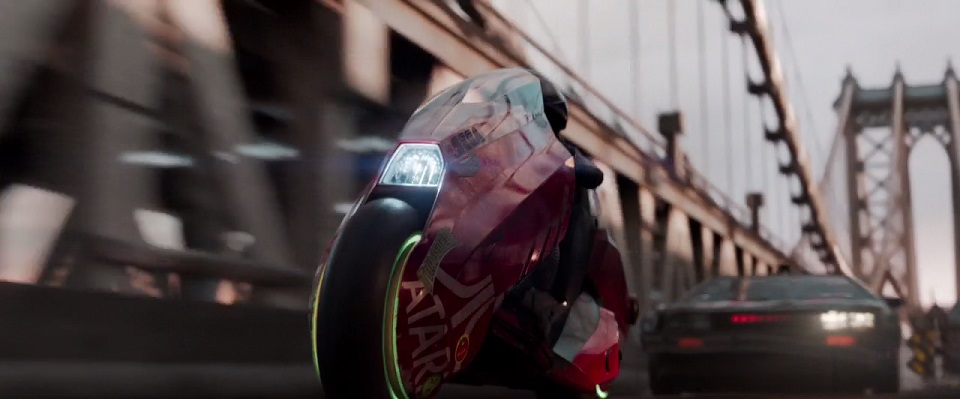
Art3mis riding Kaneda’s bike in “Ready Player One” (2018), showing the design’s enduring cultural relevance. Source: Warner Bros.
Every time I see a new homage to “the slide” in a modern film, or notice a real-world motorcycle design that seems to echo elements of Kaneda’s bike, I’m reminded of the incredible legacy of this fictional machine. It’s crossed over from being merely a part of Akira to becoming a cultural touchstone in its own right – a design so perfect and so evocative that it continues to inspire new generations of creators and fans.
And isn’t that the true mark of great art? That it lives on, influencing and inspiring long after its creation? By that measure, Kaneda’s iconic red motorcycle isn’t just a great vehicle design – it’s a masterpiece.